Where Wood Meets Earth
The Five Elements do not describe Ganoderma. Ganoderma embodies them — all at once, in a single fruiting body.
Why Five Elements Matter for a Mushroom

Walk into any traditional herb shop in Fujian or Guangdong, and you will hear the old practitioners speak of Wu Xing — the Five Phases — before they speak of anything else. Not as metaphor. As mechanism.
The system is simple at its surface: Wood generates Fire, Fire generates Earth, Earth generates Metal, Metal generates Water, Water generates Wood. Each phase nurtures the next. Each phase also restrains another — Wood binds Earth, Earth dams Water, Water extinguishes Fire, Fire melts Metal, Metal cuts Wood. This push and pull is what the ancients called balance.
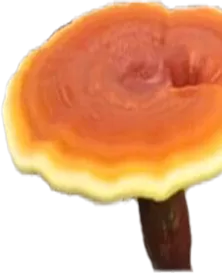
Now consider a single Ganoderma lucidum fruiting body. Its mycelium threads through decomposing hardwood — that is Wood, the phase of growth and upward movement. The cap, red-brown and glossy, is Fire in its stillness, warmth without flame. The spores it releases fall to the forest floor — Earth, the phase of grounding and nourishment. The subtle bitterness in its taste belongs to Metal, the astringent phase that clears and descends. And its affinity for the Kidney and Liver channels — that is Water, the phase of deep storage and essence.
| Element | Phase | Ganoderma Connection | Organ Channel |
|---|---|---|---|
| Wood 🌲 | Growth, expansion, upward movement | Mycelium colonizing hardwood logs; the drive to fruit | Liver |
| Fire 🔥 | Warmth, transformation, spirit (shen) | The glossy red-brown cap; calming the spirit, easing restlessness | Heart |
| Earth 🏔 | Nourishment, stability, center | Spores returning to soil; the mushroom's grounding, centering quality | Spleen |
| Metal ⚒ | Clarity, astringency, descent | The subtle bitter note; clearing and descending function | Lung |
| Water 💧 | Storage, essence (jing), deep reserve | Deep affinity for Kidney channel; nourishing foundational energy | Kidney |
The Cycle in Practice: Growing Ganoderma
If you are only going to remember one thing about the Five Elements and Ganoderma, let it be this: the cycle is not abstract when you are standing on a mountain at 800 meters.
Water is the mist that rolls into the valley each morning. Without it, the log dries and the mycelium dies. Wood is the hardwood itself — oak, chestnut, beech — the substrate the Ganoderma feeds on for eighteen months before it fruits. Fire is the warmth of the Fujian summer, the day-night temperature swing that triggers fruiting body formation. Earth is the soil the log rests on, the microbial community around the roots. Metal is the discipline of the grower — the timing of harvest, the cold-chain logistics, the refusal to cut corners.
Remove any one of these and the Ganoderma either fails to fruit, or fruits with diminished potency. This is not mysticism. It is observation, repeated across thousands of harvests over centuries.
Mountain Mist
Water element — morning fog at 800 m
Hardwood Logs
Wood element — oak and chestnut substrate
Fujian Summer
Fire element — warmth triggering fruit
Forest Floor
Earth element — soil, microbes, returning spores
Discipline
Metal element — timing, precision, no shortcuts
Why This Matters for Your Daily Life
You do not need to study classical Chinese philosophy to benefit from what it describes. The old masters were simply observing patterns — patterns that still hold.
When your mind races at night and sleep will not come, the old texts might describe it as "Fire flaring upward, Water failing to anchor." When you feel depleted, heavy, slow — that is Earth in excess, Wood unable to rise. The Five Elements are a language for describing what the body already knows.
Ganoderma, by touching all five phases, has been used for centuries as a gentle, daily support — not to force any one element, but to help the entire system find its own equilibrium. That is the deeper meaning of ping.
Is this philosophy still relevant today — or is it just ancient poetry?
Modern pharmacology has identified triterpenoids, polysaccharides, and germanium in Ganoderma — compounds with measurable effects on immune modulation, cellular oxidation, and inflammatory response pathways. The Five Elements framework is a different vocabulary for describing the same thing: a highly complex natural product with multiple simultaneous actions across multiple body systems. The ancients saw the pattern. We are still cataloguing the molecules.
Experience the balance that two thousand years of observation pointed toward.
Browse Ganoderma Collection See Where It Grows