The Five Elements — wood (木), fire (火), earth (土), metal (金), and water (水) — form one of the foundational frameworks of classical Chinese thought. Far more than a simple list of natural substances, Wu Xing describes a dynamic system of relationships: generation, restraint, and constant transformation. Understanding this theory provides essential context for how Ganoderma lucidum has been viewed in traditional Chinese medicine (TCM) for over two thousand years.
* These statements have not been evaluated by the Food and Drug Administration. This product is not intended to diagnose, treat, cure, or prevent any disease. This article discusses historical and cultural concepts for educational purposes.
The Origins of Wu Xing Theory
The Five Element theory emerged from the careful observations of the natural world by ancient Chinese scholars over thousands of years. Wood, fire, earth, metal, and water were recognized not merely as physical materials, but as fundamental categories that could explain the workings of the entire universe — from the changing seasons to the functions of the human body.
Two classical texts capture this foundational understanding. Zuo's Interpretation of the Spring and Autumn Annals (Zuo Zhuan, 左传) states: "The five kinds of materials in nature are all used by people. None of them can be dispensed with." The Book of Documents (Shang Shu, 尚书) elaborates further: "Water and fire are used for cooking; metal and wood are used for cultivating; and earth gives birth to all things, which are used by people."
These early observations evolved into a sophisticated theoretical framework — one that, alongside Yin-Yang theory, became a core pillar of TCM diagnostic and treatment philosophy.
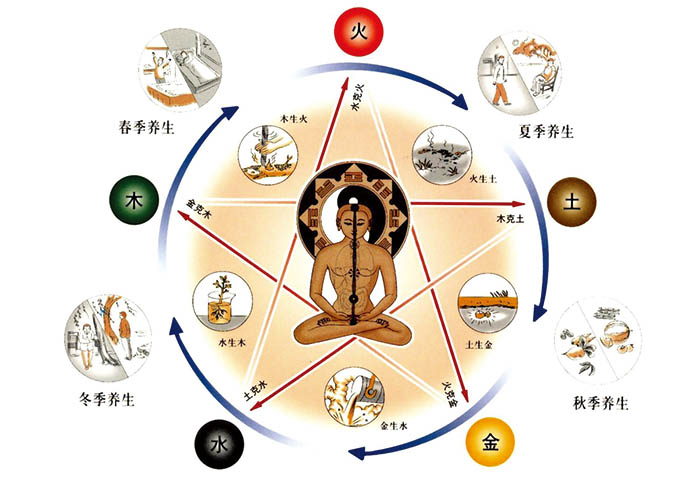
The Five Elements generative (generating) and restraining (controlling) cycles
The Two Core Relationships: Generation and Restraint
What makes Wu Xing a system rather than a list is the interplay between two fundamental cycles:
The Generating (Sheng) Cycle
Each element nourishes and gives rise to the next in a perpetual loop:
- Wood generates Fire — wood provides fuel for fire to burn
- Fire generates Earth — fire reduces matter to ash, enriching the soil
- Earth generates Metal — metals are mined and extracted from the earth
- Metal generates Water — metal condenses moisture from the air (or, in some interpretations, metal tools can dig for water)
- Water generates Wood — water nourishes trees and vegetation to grow
The Restraining (Ke) Cycle
Each element also controls or restrains another, preventing any single force from becoming excessive:
- Wood restrains Earth — tree roots hold soil in place and absorb its nutrients
- Earth restrains Water — earthen dams and banks contain the flow of water
- Water restrains Fire — water extinguishes flame
- Fire restrains Metal — fire melts and reshapes metal
- Metal restrains Wood — axes and metal tools cut through wood
Health, in the TCM view, is a state of dynamic equilibrium — neither generation nor restraint should dominate. Disease arises when these relationships are disrupted.
Where Does Ganoderma Fit in the Five Elements?
Ganoderma lucidum holds a unique position in TCM philosophy. Unlike herbs that are primarily associated with a single element, Ganoderma is traditionally classified as a superior herb (上品, shàng pǐn) in the Shen Nong's Materia Medica (Shen Nong Ben Cao Jing) — a category reserved for substances considered safe for long-term use that promote overall vitality rather than targeting a single condition.
Within the Five Element framework, Ganoderma is most commonly associated with:
Earth Element — Spleen and Stomach
Ganoderma's traditional sweet and neutral nature aligns it with the Earth element. Just as earth nourishes all living things, Ganoderma is believed to support the body's foundational digestive and metabolic functions. The Earth element governs transformation and transportation — the process of converting food into usable energy — which makes it a natural starting point for addressing imbalances throughout the body.
Wood Element — Liver
The Ganoderma mushroom has long been associated with liver support in traditional texts. In TCM, the liver belongs to the Wood element and is responsible for the smooth flow of Qi (vital energy) throughout the body. When Wood element energy is stagnant, individuals may experience symptoms of tension and restlessness. Ganoderma's traditional reputation for calming the spirit (安神, ān shén) speaks to its perceived role in supporting harmonious Wood energy.
Water Element — Kidney
As the foundation of Yin and Yang in the body, the Kidney (Water element) stores what TCM calls essence (精, jīng). Many classical texts describe Ganoderma as a substance that nourishes essence and supports vitality, placing it within the Water element's sphere of influence as well.
Beyond Disease: The Concept of Balance
It is important to understand how TCM philosophy differs from modern Western medicine. In the classical view, Ganoderma does not "cure" specific diseases. Instead, it is understood to help restore balance within the body's energy systems. When the Yin-Yang equilibrium is maintained and the Five Elements exist in harmony, the body's natural self-regulating abilities can function optimally.
This concept — that health is not the absence of disease but a state of dynamic balance — remains one of the most enduring contributions of Wu Xing philosophy to wellness thinking worldwide. Whether approached through the lens of tradition or modern integrative health practices, the Five Element framework offers a holistic perspective on the interconnectedness of body systems.
Modern Research and Traditional Wisdom
While modern science does not use the vocabulary of the Five Elements, researchers have identified several bioactive compounds in Ganoderma — including triterpenoids, polysaccharides, and organic germanium — that correspond to areas traditionally mapped within the Wu Xing framework. For example:
- Polysaccharides (associated with Earth/Spleen function) have been studied for their immunomodulatory properties
- Triterpenoids (associated with Wood/Liver function) show antioxidant activity in laboratory studies
- Unsaturated fatty acids (associated with Water/Kidney function) contribute to cellular membrane health
This convergence of ancient classification and modern biochemistry is part of what makes Ganoderma a fascinating subject for both traditional practitioners and contemporary researchers.
Frequently Asked Questions
What is the difference between the Five Elements and Yin-Yang theory?
Yin-Yang describes the fundamental duality in all phenomena — light and dark, active and passive, expansion and contraction. The Five Elements extend this by categorizing the material world and its transformations into five archetypal phases. Both systems are complementary: Yin-Yang explains what is happening; the Five Elements explain how it happens in terms of dynamic relationships.
Is the Five Element theory scientifically proven?
The Five Element theory is a philosophical framework, not a scientific hypothesis in the modern sense. It is best understood as a conceptual model that ancient scholars used to organize their observations of nature and health. While modern research on Ganoderma has identified bioactive compounds with measurable effects, the Five Element framework is a cultural and historical lens rather than a laboratory model.
How do I incorporate Ganoderma into a balanced wellness routine?
Whether you approach it through traditional philosophy or modern nutrition, consistency is key. Our Ganoderma products — including spore powder, spore oil, and capsules — offer different delivery formats. Start with the recommended serving size and pay attention to how your body responds over the course of several weeks.